27.06.2022
The recovered, gothic altar returns to St. Mary’s Church in Gdańsk
The valuable monument has been in Berlin for 78 years. It returned to Poland under an agreement between the Polish Catholic Church and the Evangelical Church in Berlin.
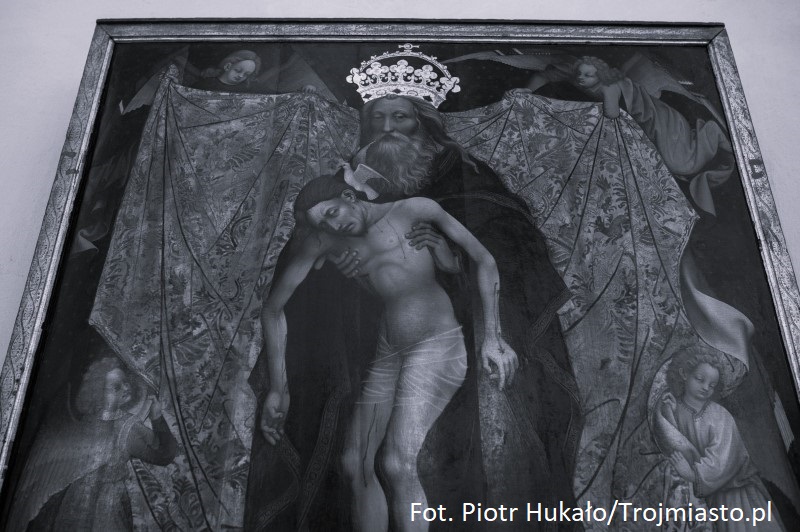
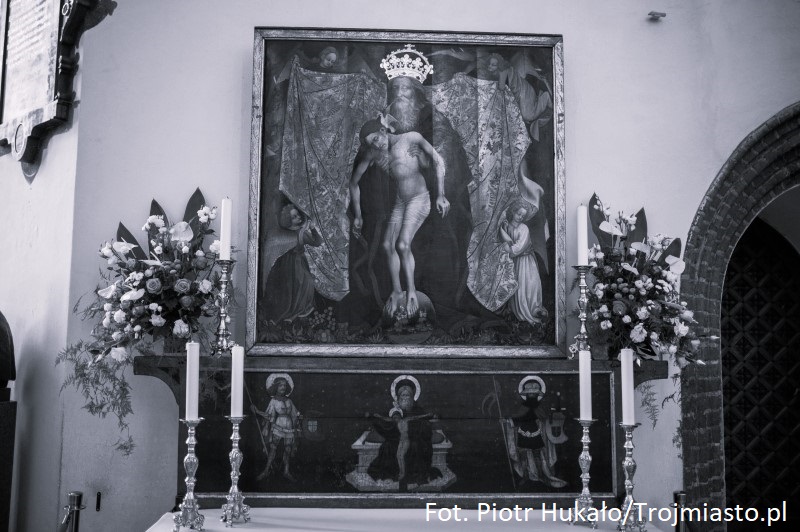
The painting is dated to the 20s of the 15th century. It presents the Holy Trinity in the Pietas Domini type – God the Father supports the body of Jesus, and between their heads there is the Holy Spirit in the form of a dove. Predella (the lower part of the altar in the form of a decorated chest) dates from 1400-1420.
Altar of the Holy Trinity of the Brotherhood of St. George was the most valuable work of art in the Church of Our Lady in Gdańsk, before Hans Memling’s “The Last Judgment” was located there. The painting was made in tempera technique on wood with the use of golden foil. The author of the work is unknown, but historians point to the workshop of an unknown master from Gdańsk.
Two years ago, immediately after the altar – plundered in 1943 – was recovered, it was placed in the sacristy of St. Mary’s Basilica, where it went into “quarantine” – to get used to the local humidity and temperature.
In June 2022, the valuable monument returned to its former place – the nave of the Basilica. The liturgical welcome of the altar was an ecumenical prayer, led by Christian Stäblein, bishop of the Evangelical Church of Berlin, Brandenburg and Upper Silesia, and Archbishop Tadeusz Wojda, Metropolitan of Gdańsk. Church leaders declared that they would talk about the return to St. Mary’s Basilica in Gdańsk of other works of art taken to Germany during World War II.
St. Mary’s Basilica – the largest brick temple in Europe, known as the “Crown of Gdańsk”.
St. Mary’s Basilica is one of the largest religious buildings in Europe. The temple is 105 meters long, 66 meters wide and has a cubature of about 155,000 m3. It was built for over 150 years, from the mid-fourteenth to the end of the fifteenth century. It is surrounded by 31 chapels. Inside, 26 pillars support a stellar and crystal vault, up to 30 m high.
Initially, Catholic and Protestant masses were celebrated in the Basilica. At the end of the 16th century, the Basilica became an exclusively Protestant church. In 1945, a large part of the temple was destroyed. In 1952, the reconstruction of the church began, which was completed at the end of 1955. Since then, it has been a Catholic church.
The interior of the church is illuminated by 41 huge windows, the largest of which, decorated with a stained-glass, is in the eastern part of the presbytery. There are 7 gates to the interior of the church: Kaletnicza, Radnych, Wysoka, Mariacka, Groblowa, above it the “Groblowy” clock from 1635-37, Szewska, whose tympanum is decorated with the “Scene of the Dormition of Mary” from 1420 and the gate under the tower. Above the temple there are 7 spiers, 3 ceramic towers and a massive 82 m high belfry with two roofs, between which there is an observation deck.
Inside the church you can admire, among others oak, late gothic main altar from 1517 depicting the scene of the Coronation of the Blessed Virgin Mary. In the sacristy there is a work by H. Duringer from Toruń – a reconstruction of the famous astronomical clock from 1464-1470. The 12-meter clock shows the hours, moon phases and zodiac signs.
The long list of famous monuments of St. Mary’s Basilica includes the sculpture of the Beautiful Madonna of Gdańsk, carved in the years 1400-1435, and the Pieta – a Gothic sculpture. The floor consists of about 400 tombstones, under which distinguished residents of Gdańsk were buried. The oldest tombstone is from 1411. The first mayors of Gdańsk, Konrad Leczkow and Arnold Hecht, are buried under it.
When writing about works of art from St. Mary’s Basilica, it is impossible to ignore Hans Memling’s triptych “The Last Judgment”. In the temple, you can see a 19th-century copy of the famous work. The original is in the National Museum in Gdańsk. The triptych is one of the most outstanding and best-preserved examples of Dutch painting in the world. Over the centuries, many powerful and influential collectors have wanted it in their collections. It has been captured, stolen, hidden and unlawfully held. In 1956 it returned to Poland. But it did not return to St. Mary’s Basilica.